Context & Problem
While building my 2025 portfolio, I wanted to solve the same architectural challenges I had repeatedly encountered in enterprise environments:
Content bottlenecks — Marketing and business stakeholders depended on developers to publish content, slowing time-to-market.
Design inconsistency — New pages were created without a standardized component system, resulting in UI drift.
Limited scalability — Each new feature required duplicating effort across design, development, and content authoring.
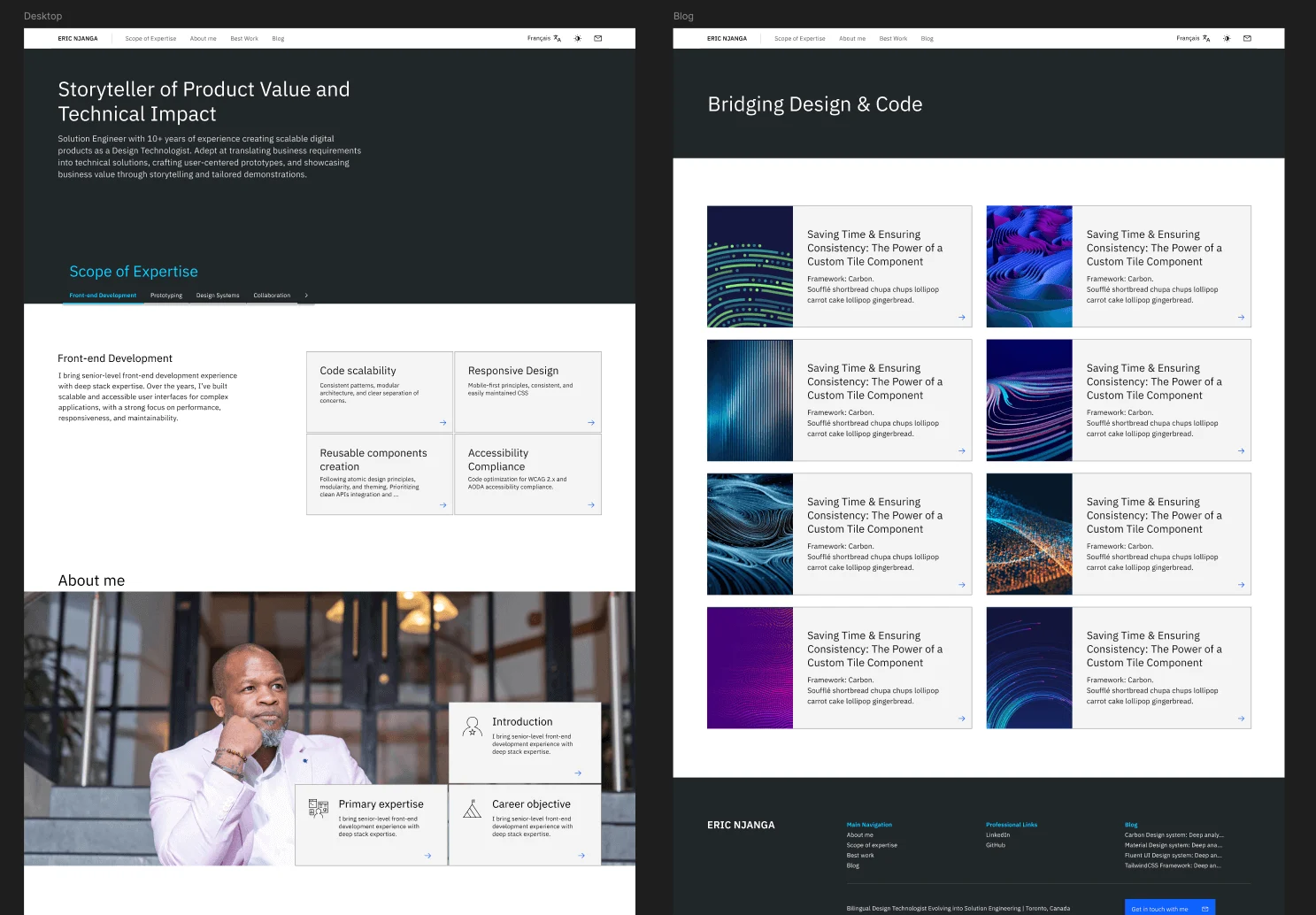
Over the course of my career, I have seen these issues increase maintenance costs and reduce organizational agility. For my 2025 portfolio, I deliberately treated the site as an enterprise-grade platform rather than a simple marketing website.
Solution
I built my 2025 portfolio as a headless, CMS-driven application using React, Next.js, Contentful, and a custom React component library.
Each architectural decision was tied directly to business outcomes:
Reusable, CMS-driven components → Accelerated feature delivery and reduced code duplication.
Design-system governance → Strengthened brand consistency and minimized UI drift.
Content decoupled from code → Enabled non-technical publishing without developer intervention.
Accessibility by default → Reduced compliance risk and expanded audience reach.
SEO and performance optimization → Leveraged Static Site Generation (SSG) for fast, discoverable pages.
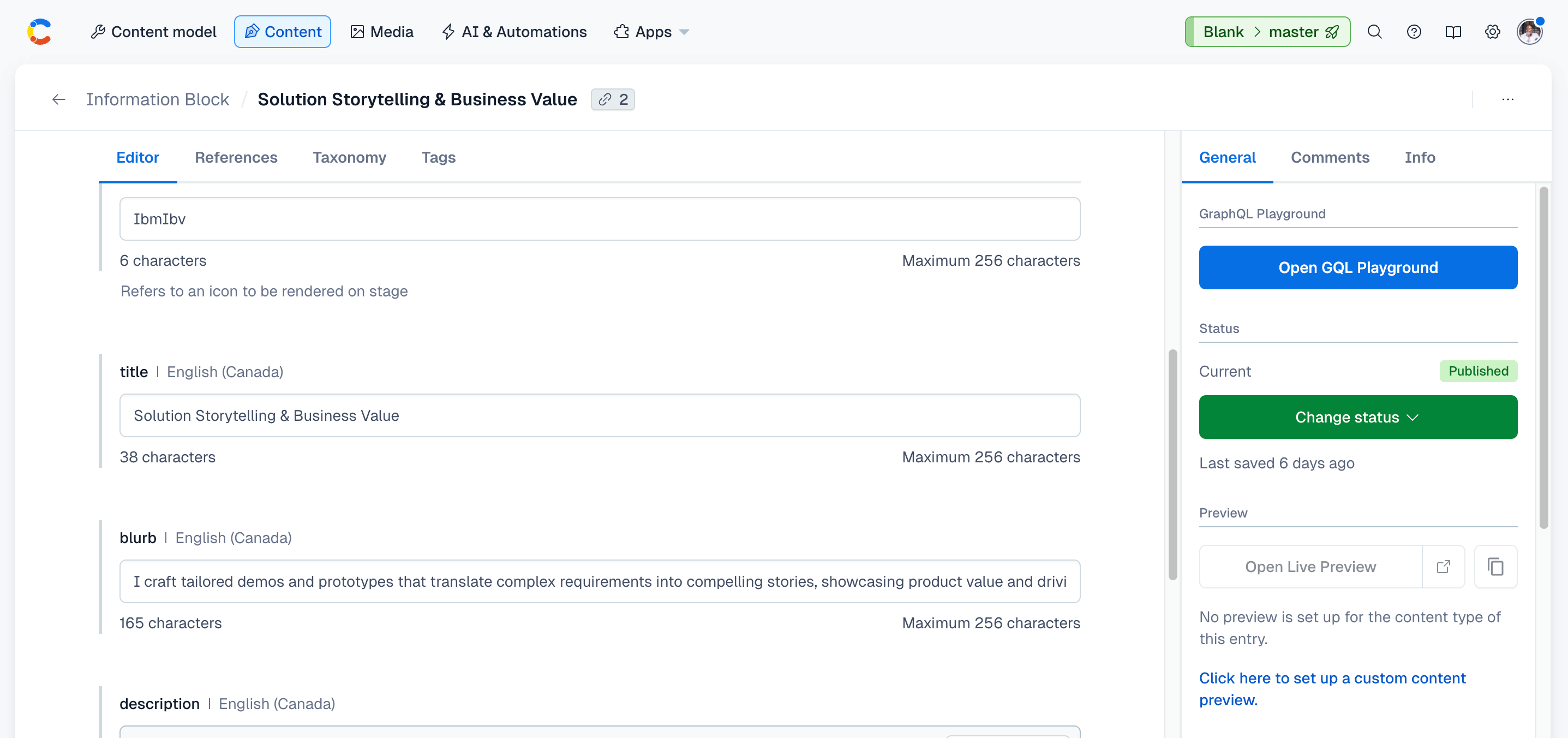
Demonstrates how structured CMS content is transformed into dynamic pages using reusable React components.
Implementation
I built the platform on top of the Carbon Design System, selected Next.js for its hybrid rendering architecture, and adopted Contentful for its structured content modeling and GraphQL API.
Tech Stack & Architecture
Framework: Next.js (folder routing, server-side and client components, renderding methods, optimization).
CMS: Contentful (for structured content modeling and editorial flexibility).
UI Foundation: Custom React component library (ensuring accessibility, consistency, and reusability).
Documentation: Storybook (for component showcase and developer onboarding).
CI/CD: Vercel (for automated build, test, and deploy).
Example: Page Assembly with Contentful + Component Library
The platform assembles pages using a modular architecture:
Content authors compose pages by referencing reusable modules such as hero banners, cards, and media blocks.
React components consume structured GraphQL data and render accessible, responsive layouts.
Design tokens enforce consistent typography, spacing, and color usage across the entire application.
Impact
✨ Business + Technical Outcomes:
Because the component library was already in place, development effort could focus on platform architecture, routing, and CMS integration rather than rebuilding UI elements from scratch.
Key outcomes for my 2025 portfolio:
~40% faster feature delivery through reusable, CMS-driven components.
Editorial autonomy enabling content updates and publishing without developer support.
Design-system enforcement reducing visual inconsistency and accessibility defects.
Improved scalability allowing new pages and features to be assembled rapidly.
Reduced maintenance overhead by centralizing UI patterns in a single component library.
📊 Analytics dashboard coming soon. The platform is live and collecting usage data to validate its business value and user engagement.
Solution Engineering Mindset
This project illustrates how I approach software development as a Design Technologist and Solution Engineer.
Business Alignment: Architected the platform to eliminate publishing bottlenecks and improve marketing agility.
Cross-Functional Thinking: Designed reusable modules that align design, engineering, and content operations.
Platform Architecture: Built a scalable foundation rather than a one-off website.
Team Enablement: Used Storybook to document components and accelerate onboarding.
Shows how components are documented, tested, and consumed by the Contentful-powered application.
Commitment to Quality
My 2025 portfolio serves as a production-grade reference architecture for enterprise digital platforms.
Quality objectives include:
Performance benchmarking using Lighthouse and Core Web Vitals
Automated testing covering unit and integration scenarios
Technical SEO using Static Site Generation and Server Components
Accessibility conformance aligned with WCAG 2.1 AA
Future enhancements including localization, visual regression testing, and multi-site support
✨ Takeaway
This project demonstrates how I transform design requirements into scalable business platforms.
I design systems, not isolated pages.
I build platforms, not one-off features.
I create architectures that empower teams, streamline workflows, and deliver measurable business value.
Next steps
My next goal is to:
Optimizing core web vitals by eliminating render-blocking CSS in my 2025 portfolio
Re-architect my 2025 portfolio to better showcase organizational impact and career progression