My 2025 portfolio is built with Next.js, leveraging modern rendering and routing patterns to create a scalable, maintainable, and high-performance professional platform.
Why Next.js Was the Right Architectural Choice
I built my 2025 portfolio with Next.js 13+ and the App Router because it aligns with both my technical standards and business objectives:
File-based routing and nested layouts for scalable information architecture
Native integration with headless CMS platforms such as
Contentful
Static Site Generation (SSG) for exceptional performance
Built-in SEO, metadata management, and accessibility support
Server Components for optimized rendering and reduced client-side JavaScript
How the Application Is Structured
The platform follows the App Router architecture introduced in Next.js 13+, which provides a clear separation between routes, layouts, and rendering responsibilities.
1 — File-Based Routing and Information Architecture
The application contains five primary routes and a single shared layout.tsx wrapper that defines the global shell, metadata, and persistent UI elements.
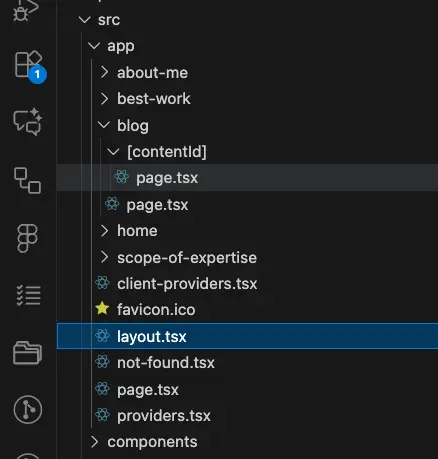
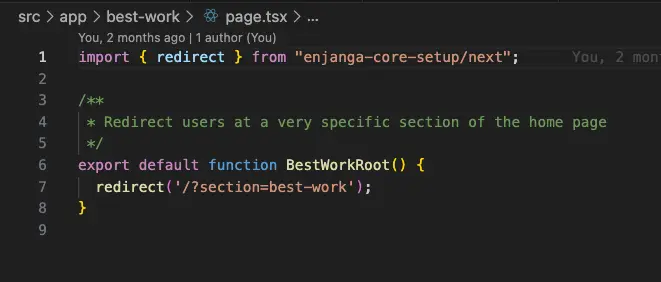
Three of these routes represent lightweight sections rather than full pages. When users navigate to them, the application redirects to the homepage and automatically scrolls to the corresponding section.
This approach delivers clean URLs while preserving a single-page browsing experience.
2 — Rendering Strategy: Static Site Generation (SSG)
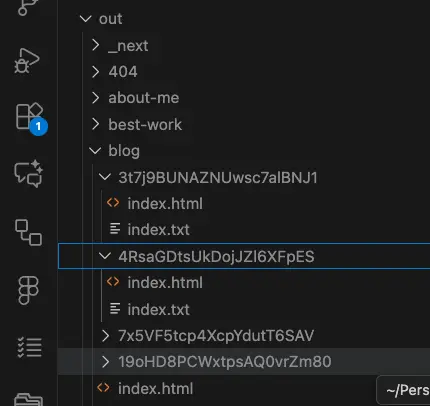
The entire platform is pre-rendered using Static Site Generation.
During the build process, content is fetched from Contentful and transformed into static HTML files that are deployed to the CDN.
Because the portfolio is content-driven and does not require real-time updates, SSG provides the ideal balance of speed, scalability, and operational simplicity.
Since the platform does not rely on frequently changing data or complex client-side state, Static Site Generation delivers the most efficient and performant rendering model.
3 — Server Components vs. Client Components
I default to Server Components whenever possible to minimize JavaScript sent to the browser and improve Core Web Vitals.
Server Components are responsible for:
Fetching CMS data
Generating SEO metadata
Rendering content-heavy page structures
Reducing client-side bundle size
Client Components are introduced only when browser-specific APIs, DOM interactions, or stateful React hooks are required.
This architecture keeps the application highly performant while preserving rich interactivity where needed.
4 — Server-Side Data Fetching
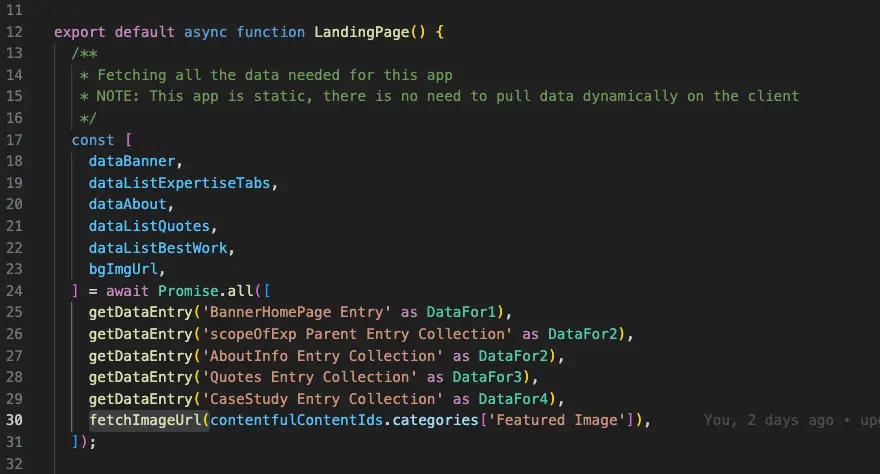
All CMS requests are executed on the server during the build step.
Content is retrieved from Contentful and distributed through:
Props for route-level components
Context providers for deeply nested component trees
Centralizing data access simplifies debugging, improves maintainability, and ensures predictable rendering behavior.
Optimization and Caching
Next.js provides several caching mechanisms that complement the SSG architecture:
Build-Time Caching — Pre-rendered pages are distributed through CDN edge nodes
Fetch Caching — Server-side fetch() requests are cached automatically
Full Route Caching — Routes remain static by default unless explicitly marked as dynamic
These optimizations significantly reduce latency and virtually eliminate runtime server overhead.
Key Outcomes
By combining Next.js, Static Site Generation, and Contentful, I built a platform that delivers measurable architectural benefits:
Near-instant page loads
Excellent SEO performance
Minimal infrastructure complexity
Centralized content management
Scalable and maintainable codebase
Reduced client-side JavaScript footprint
Takeaways and Future Exploration
Next.js enabled me to build a production-grade platform that balances business goals, developer experience, and long-term maintainability.
The combination of App Router, Server Components, and Static Site Generation provides a robust foundation for delivering high-performance digital experiences.
Next steps
In future iterations, I plan to explore:
Incremental Static Regeneration (ISR)
Client-Side Rendering (CSR) patterns
Authentication and authorization (OAuth 2.0)
JSON Web Tokens (JWT)
Global state management with Zustand
Edge middleware and advanced caching strategies